The shape of the tower
A triangle at the foot, a circle at the top
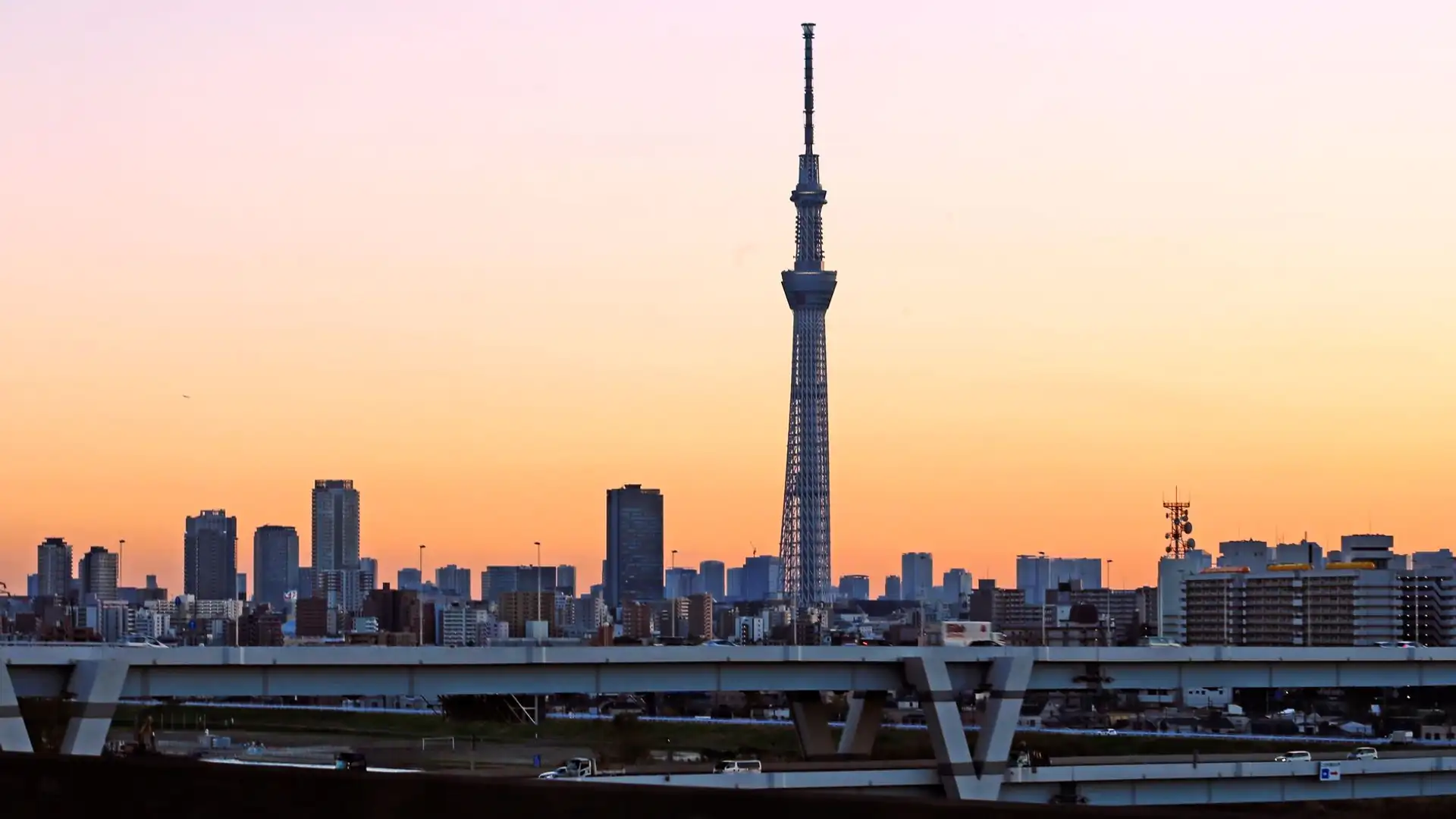
Skytree is not one shape stacked on itself. Its cross-section changes continuously as it rises — a triangle where the three legs meet the ground, a circle by the time it reaches the decks. The transition is what produces the tower's two famous curves: sori, the concave sweep of a sword blade, on one silhouette, and mukuri, the gentle convex swell of a temple column, on another. Which one you see depends entirely on where in Tokyo you are standing.
If you have any flexibility, aim for a clear morning in the cooler months: that is when the air over the Kanto plain is sharpest and Mount Fuji is most likely to be sitting on the western horizon. Sunset is the slot everyone wants and the first to go — the light is superb, but you are sharing the west-facing glass with a crowd, and the tower does genuinely sell out on holidays and weekends.
- 0 m
Three legs set in a triangle about 68 metres to a side. The tripod was not a style choice — the riverside plot was too tight for a square footing, and the legs run down into underground walls shaped like the roots of a tree.
- 125 m
The corners have begun to soften and the outer frame has separated from the concrete core. Everything above this height moves independently of the shaft inside it.
- 320 m
The section is almost round. This is roughly the height of the Eiffel Tower, and it is not yet halfway up.
- 350 m
Tembo Deck — three floors, 340, 345 and 350. The glass floor is on 340; the highest of Japan's cafes is on 350.
- 450 m
Tembo Galleria — a sloping glass tube that spirals 110 metres around the tower to Sorakara Point, the highest place a visitor can stand, at 451.2 metres.
- 634 m
The tip of the broadcast mast. Six-three-four reads in Japanese as mu-sa-shi — Musashi, the old province that covered what is now Tokyo.
After dark
Iki and Miyabi — the tower has two nights
Skytree does not have one night-time appearance. Two lighting designs alternate from one evening to the next, and they are not colour variations of the same idea — they light different parts of the structure.
-
Iki
chic
Edo blue. The light picks out the central shaft and leaves the outer lattice dark, so the tower reads as a single pale column standing in the sky. The name is an Edo-period aesthetic word for understated stylishness — the opposite of showing off.
-
Miyabi
elegance
Imperial purple, with the outer steel lit and gold accents along the frame. Where Iki hides the structure, Miyabi displays it. The word belongs to the refined court culture of the Heian capital.
-
Nobori
rising
A warm orange-gold added to the rotation later. Worth knowing about so you are not surprised when the tower is neither blue nor purple on the night you look up.
Tokyo Skytree at a glance
How it stands up
There is a pagoda hidden in the middle
Run a lift shaft up the centre of a 634-metre tower and you have a problem: in an earthquake the core and the frame want to move at different speeds. Japanese carpenters solved this in wood in the seventh century, and Skytree's engineers copied them in reinforced concrete.
A reinforced-concrete shaft runs up the core of the tower and is tied to the outer steel frame only near the bottom. Above that it hangs free, damped with oil, so that in an earthquake the core and the frame move out of step and cancel each other. The idea is lifted from the shinbashira, the central pillar of a five-storey wooden pagoda — a technology roughly 1,300 years old.
Tokyo Skytree opening hours
- Tembo Deck and Tembo Galleria
- Generally daily 10:00–22:00 JST, last entry 21:00
- Regular closing day
- None — the tower opens every day of the year
- Tokyo Solamachi (the complex at the base)
- Shops generally 10:00–21:00; restaurant floors later
- Extreme weather
- The decks can close at short notice in high wind, lightning or typhoon conditions
Hours are extended on some holidays and shortened on a small number of days each year for maintenance. Because your ticket is for a specific arrival window, check the operator's own calendar for your date if you are booking around an early opening or a late slot.
Book your entry
Tokyo Skytree admission tickets
Dated, timed entry to the Tembo Deck at 350 metres, with the option to add the Tembo Galleria at 450 metres. Booked through GetYourGuide, who list it as an official ticket.
See Tokyo Skytree tickets & times ↗- Valid 1 day
- Free cancellation
Top-rated Tokyo experiences
In-depth Tokyo Skytree guides
When to visit Tokyo Skytree
Read more → Two towers, ten kilometres apart, and they are not competing for the same visitTokyo Skytree or Tokyo Tower — which should you go up?
Read more → 350 metres or 450 metres — what the upgrade actually gets youTembo Deck or Tembo Galleria?
Read more → The tower sits on top of two railway stations, which makes this easier than most Tokyo journeysGetting to Tokyo Skytree
Read more → It is about 100 kilometres away and visible on a minority of days — here is how to improve your oddsCan you see Mount Fuji from Tokyo Skytree?
Read more → The glass is the enemy — everything else is manageablePhotographing Tokyo Skytree, inside and out
Read more → A very tall tower, a glass floor, an aquarium and a planetarium in one buildingTokyo Skytree with children
Read more → Tokyo's oldest temple and its tallest tower are twenty minutes apart on footSkytree and Asakusa in one day
Read more → You can, it costs more, and on a lot of days you will not get inCan you buy Tokyo Skytree tickets on the day?
Read more → A tripod, a shape-changing section, and a 1,300-year-old anti-earthquake trickHow Tokyo Skytree was built
Read more →Good to know
Tokyo Skytree questions
What is the difference between the Tembo Deck and the Tembo Galleria?
The Tembo Deck at 350 metres is the main observation level — three floors of gallery running right around the tower, with floor-to-ceiling glass, a cafe and the section of glass floor on floor 340. The Tembo Galleria at 450 metres is a separate, higher level: a sloping glass-walled tube that spirals about 110 metres around the outside of the tower up to Sorakara Point at 451.2 metres, the highest spot open to visitors. The Galleria is an add-on — you cannot visit it without a Deck ticket.
Is the Tembo Galleria worth the extra?
It depends what you want from the visit. The Galleria's appeal is the ramp itself: a long, gently climbing glass tunnel with the structure visible overhead and the city dropping away beneath you. The view is higher but not dramatically different — by 350 metres you are already above everything. If you are a nervous flyer, short of time, or travelling with small children, the Deck alone is the sensible choice. If you want the whole tower and the vertigo, add it.
Can you see Mount Fuji from Tokyo Skytree?
On a clear day, yes — Fuji sits on the western horizon roughly 100 kilometres away. It is far from guaranteed. Your best odds are crisp mornings in the colder months, particularly after rain or wind has cleared the air, and your worst are humid summer afternoons when the plain hazes over. No ticket can promise it, and the operator does not.
Does the ticket have a fixed time slot?
Yes. Skytree uses timed entry, so your ticket is for a specific arrival window on a specific date rather than for the day in general. You choose the window when you book, then go straight to the 4th floor of the tower base at that time and scan the code on your phone.
Can Tokyo Skytree sell out?
Yes, genuinely. Sunset windows, weekends, Japanese public holidays and the New Year period all sell out, and walk-up visitors are turned away or face a long wait at the base. If your date is fixed and you want a particular time of day, book it rather than leaving it to the morning.
How long does a visit take?
Allow about an hour to an hour and a half for the Tembo Deck on its own, and around two hours if you add the Galleria. That is time on the decks; it does not include the lift queues at busy periods, and it certainly does not include Tokyo Solamachi, the very large shopping and dining complex at the base, which can absorb an entire afternoon if you let it.
Is there really a glass floor?
Yes — on floor 340, the lowest of the Tembo Deck's three levels. A section of the floor is glass, looking straight down the outside of the tower to the streets 340 metres below. It is one of the most photographed spots in the building and there is usually a short, good-natured queue to stand on it.
What happens if the weather is bad?
The decks stay open in cloud and rain, and low cloud can be spectacular in its own right — the tower punches through it and you look out over the top. What you lose is the distance: no Fuji, no far horizon. In genuinely severe weather, high wind or lightning, the decks can close at short notice, in which case the operator's own conditions apply to your booking.
Why is the tower 634 metres tall?
It is a pun. The digits six, three and four can be read in Japanese as mu-sa-shi, and Musashi was the old province covering what is now Tokyo and its surrounds. The height was chosen to make that reading work, and it also made Skytree the tallest tower in the world when it opened.
How do I get to Tokyo Skytree?
It is one of the easiest major sights in Tokyo to reach, because it sits directly on top of its own stations. Tokyo Skytree Station on the Tobu Skytree Line is at the foot of the tower, and Oshiage — served by the Tokyo Metro Hanzomon Line, the Toei Asakusa Line and the Keisei lines — connects straight into the base complex. Asakusa is about a twenty-minute walk across the Sumida, or one stop on the train.